Image
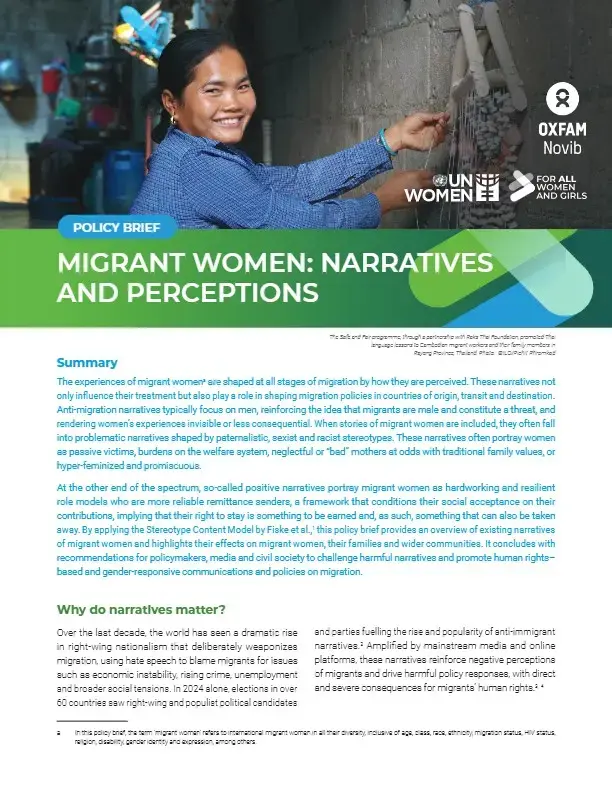
Across the world, migrant women’s experiences are shaped by how they are perceived. From media portrayals to political rhetoric, the stories told about them influence public opinion, social attitudes and, ultimately, migration policies. Too often, these narratives are rooted in sexist, racist, and paternalistic stereotypes—casting women as passive victims, burdens on welfare systems, or threats to cultural values. Even when framed positively, portrayals that celebrate migrant women solely as resilient workers or role models risk reducing their identities to their economic contributions.
This policy brief, developed by UN Women and Oxfam as part of the Making Migration Safe for Women Programme, examines how these narratives take shape and why they matter. Using the Stereotype Content Model, it analyses the common patterns that underpin public perceptions—from pity and admiration to envy and contempt—and the impact these have on migrant women’s rights, well-being, and visibility.
By highlighting examples from diverse contexts, the brief calls attention to how harmful narratives reinforce discrimination and justify exclusion. It also offers practical recommendations for governments, the media, and civil society to challenge these stereotypes and promote gender-responsive, human rights–based storytelling.
The brief urges a shift towards narratives that recognize migrant women’s agency and contributions while confronting the structural inequalities that shape their lives.